Article
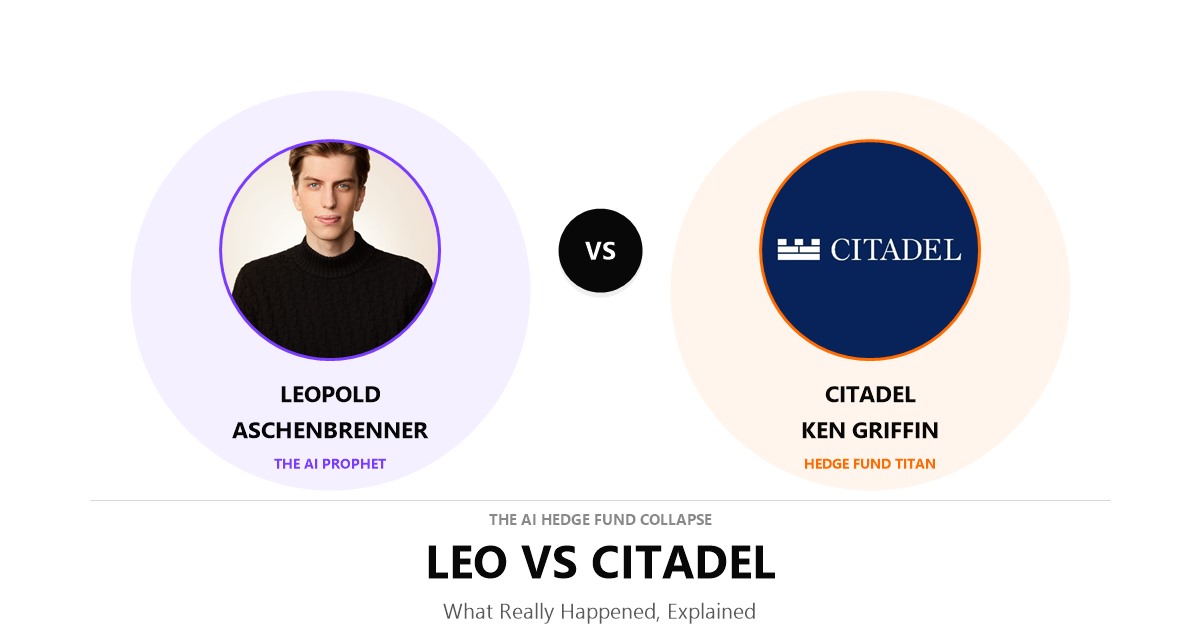
Leopold Aschenbrenner vs Citadel: What Happened
AI Summary click to expand
Generate a quick summary of this article with an AI model of your choice. Your API key stays in this browser only and is never sent to this site's server.
If your social feed has been full of edits showing Ken Griffin’s Citadel “mogging” a 25 year old AI wunderkind, you’ve probably had the same question everyone else has: what actually happened here, and is it as dramatic as the memes make it look?
Short answer: yes, mostly. And it’s a useful story for anyone who runs a business and has ever been tempted to bet big on a good idea without a backup plan.
Here’s the real, non meme version of the Leopold Aschenbrenner vs Citadel story, what led up to it, and what small business owners and startup founders can actually take away from it.

Photo by Steve Johnson on Unsplash
Who is Leopold Aschenbrenner?
Leopold “Leo” Aschenbrenner is a German born researcher and investor who became one of the most talked about names in Silicon Valley almost overnight. He enrolled at Columbia University at 15, graduated as valedictorian at 19 with degrees spanning math, statistics, and economics, and went on to join OpenAI’s “superalignment” team, the group focused on making sure advanced AI systems stay safe as they get more powerful.
He left OpenAI in 2024 under circumstances he has publicly disputed. OpenAI framed his departure as tied to mishandling internal information; Aschenbrenner has said he shared a largely non confidential planning document with outside researchers and that his exit followed disagreements over the company’s security practices.
Later that year, he published a sprawling essay called “Situational Awareness,” which argued that the world was underestimating how fast artificial general intelligence was coming, and that this would require massive buildouts in compute, semiconductors, energy, and infrastructure. The essay went viral in tech and policy circles and effectively turned him into a prophet figure for the AI infrastructure boom.
Backed by investors including Patrick and John Collison, Daniel Gross, and Nat Friedman, he launched a hedge fund named after that essay: Situational Awareness LP.
What was the Situational Awareness fund?
Situational Awareness was built around a fairly simple, if aggressive, thesis: go long on companies powering the AI buildout (chips, memory, cloud infrastructure) and short companies that Aschenbrenner believed would be disrupted by AI, including some software firms.
For a while, the strategy worked spectacularly well.
- The fund reportedly delivered returns north of 1,000% since its 2024 inception.
- Through June 2026, it posted a staggering 439% return, driven by concentrated bets on names like SK Hynix, Nebius, and Micron.
- Assets under management ballooned from roughly $1.5 billion in 2025 to a peak of around $45 billion by early July 2026.
That’s a fund run by a team of about a dozen people managing more capital than many multi decade, multi strategy firms ever accumulate. It’s easy to see why it became a Wall Street and tech media obsession.

Photo by Maxim Hopman on Unsplash
What went wrong in July 2026?
Then came July.
According to reporting from CNBC, Reuters, the Wall Street Journal, and TechCrunch, the fund’s public equities portfolio, roughly $16 billion in size, lost about 67% of its value in a single month. Several factors combined at once:
- A broad AI infrastructure selloff. Public markets grew nervous that massive AI capital expenditure wasn’t translating into near term revenue, and hard hit names like SK Hynix, Sandisk, Bloom Energy, and Nebius Group each fell more than 30% in a matter of weeks.
- The short book didn’t offset the losses. Aschenbrenner’s bearish bets against software companies like Adobe moved the wrong way at the same time the long positions were falling, so the hedge wasn’t much of a hedge.
- Heavy leverage amplified everything. Reports indicate the fund used leverage as high as 400%, meaning even a moderate move against its positions could produce outsized losses.
- Margin calls forced the fund’s hand. Prime brokers, reportedly including Bank of America, Goldman Sachs, and JPMorgan, required the fund to post more collateral or unwind positions. With the portfolio underwater and highly leveraged, Situational Awareness didn’t have much room to negotiate.
By the time the dust settled, the fund’s overall assets had fallen from a peak of roughly $45 billion to around $10 billion.

Photo by Pedro Lastra on Unsplash
Where Citadel comes in
This is the part that got turned into a thousand Instagram edits.
To meet those margin calls, Situational Awareness was forced to sell the bulk of its leveraged public stock positions, reportedly including SK Hynix and CoreWeave, in a block trade to Ken Griffin’s Citadel. Reuters reported that Citadel’s co Chief Investment Officer Pablo Salame and other senior leaders spent hours combing through the fund’s positions before agreeing to the deal, and that Citadel picked up the portfolio at a meaningful discount to market value, reportedly around 10% below where the stocks were trading.
Citadel didn’t “attack” Aschenbrenner’s fund. It stepped in as a buyer at a moment when Situational Awareness had no real choice but to sell, and it negotiated favorable pricing because it was the one holding the leverage in that conversation. That’s a fairly normal, if brutal, part of how institutional finance works when a highly leveraged fund gets caught on the wrong side of a fast market move.
The fund didn’t disappear. It still holds private investments, most notably its stake in Anthropic, and Aschenbrenner has continued running the firm. In a July 24 letter to investors, reported by the Financial Times, he described the selloff as one of the best buying opportunities the fund had seen and invited clients to commit fresh capital starting August 1, though Bloomberg later reported that appeal didn’t attract the commitments he had hoped for.
Situational Awareness: before and after July 2026
| Metric | Peak (Early July 2026) | After the Selloff (Late July 2026) |
|---|---|---|
| Total assets under management | ~$45 billion | ~$10 billion |
| Public equities portfolio | ~$16 billion | Mostly sold to Citadel |
| Monthly return on public book | N/A | Roughly negative 67% |
| Reported leverage used | Up to 400% | N/A |
| Return since 2024 inception | Over 1,000% (through June 2026) | Still positive, but sharply reduced |
| Key long positions | SK Hynix, Nebius, Micron, CoreWeave, Sandisk | Largely unwound (public side) |
| Remaining assets | N/A | Private holdings, including Anthropic stake |
Why this story blew up online
Beyond the raw dollar figures, a few things made this story catnip for social media:
- The age gap in the narrative. A 25 year old “AI prophet” versus Ken Griffin, one of the most established names in finance, is an easy story to compress into a meme.
- The speed of the reversal. Going from a 439% return to a 67% monthly loss in a matter of weeks is dramatic by any standard.
- The size of the numbers. Billions of dollars moving in a single trade is inherently attention grabbing, even to people who don’t follow markets closely.
- The “prophet falls” narrative. Aschenbrenner had positioned himself, through his widely read essay, as someone who understood the future of AI better than almost anyone. A public, well documented loss creates an obvious narrative tension with that reputation.
None of that means the coverage was fair or complete. Aschenbrenner’s fund is still operating, still holds a meaningful private portfolio, and by most accounts remains a serious, well capitalized firm even after the July losses. The “Citadel mogging Leo” framing makes for a great video edit. The actual story is a hard lesson in leverage and risk management.
What business owners can actually learn from this?
You don’t need to run a hedge fund for this story to be relevant. The underlying mistakes are ones small business owners, startup founders, and even local business operators make on a smaller scale all the time.

Photo by Sean Pollock on Unsplash
1. Concentration risk isn’t just a stock market problem
Aschenbrenner’s fund put enormous conviction behind a narrow set of AI infrastructure bets. When that sector turned, there was nothing to cushion the fall. If your business depends heavily on one client, one supplier, one marketing channel, or one product line, you’re carrying a similar kind of concentration risk. Diversifying your revenue sources, even modestly, is one of the cheapest forms of insurance available to any business.
2. Leverage cuts both ways
Borrowed capital, whether it’s investment leverage, a business line of credit, or aggressive inventory financing, can accelerate growth when things go well and accelerate losses when they don’t. Before taking on debt to scale faster, stress test the downside: what happens to your cash flow if revenue drops 30% next quarter? I cover this exact math in detail in my guide on when borrowing is actually a good decision.
3. A hedge is only useful if it actually offsets your risk
The fund’s short positions were supposed to balance its long bets, but they moved the wrong way at the wrong time. In business terms, a “backup plan” that fails under the exact same conditions as your main plan isn’t really a backup plan. Test your contingency plans against realistic worst case scenarios, not just mild ones.
4. Reputation and performance are two different things
Aschenbrenner built enormous credibility through a single essay before he’d made a single trade. That credibility helped him raise capital fast, but it also meant the fall was more public than it might otherwise have been. For business owners, the lesson is to make sure your operations can back up the reputation you’re building, especially online, where local customers and clients often judge a business by its digital presence before they ever walk through the door.
5. Fast growth needs fast, honest communication
When the losses hit, Aschenbrenner sent investors a direct letter acknowledging the disappointment rather than going quiet. Whatever you think of the fund’s risk management, that kind of transparency during a rough patch tends to preserve more trust than silence does. The same applies to any business relationship, with customers, clients, or partners.
Key takeaways:
- Situational Awareness, Leopold Aschenbrenner’s AI focused hedge fund, grew from roughly $1.5 billion to a peak of about $45 billion between 2025 and early July 2026.
- In July 2026, the fund’s public equities portfolio lost about 67% of its value due to a broad AI infrastructure stock selloff, an ineffective short book, and up to 400% leverage.
- Margin calls forced the fund to sell the bulk of its leveraged public holdings, roughly $16 billion, to Ken Griffin’s Citadel at a discount.
- Citadel didn’t target the fund; it acted as a buyer during a distressed sale, a normal, if harsh, part of institutional finance.
- The fund still exists and retains private holdings, including its Anthropic stake, and Aschenbrenner has continued to run it.
- The bigger lesson for business owners is about concentration risk, leverage, and having contingency plans that hold up under pressure, the real substance behind the social media rivalry narrative.
Related questions
What actually happened between Leopold Aschenbrenner and Citadel?
Aschenbrenner’s hedge fund, Situational Awareness, suffered a roughly 67% loss on its public equities portfolio in July 2026 after an AI stock selloff and heavy leverage. Margin calls from its prime brokers forced the fund to sell most of that portfolio, around $16 billion, to Ken Griffin’s Citadel at a discount.
Did Citadel buy out Leopold Aschenbrenner’s entire fund?
No. Citadel purchased the bulk of the fund’s public equity holdings in a block trade. Situational Awareness retained its private investments, including its stake in Anthropic, and continues to operate.
Why did Situational Awareness lose so much money so fast?
A combination of factors: a sharp selloff in AI infrastructure stocks, short positions in software companies that moved against the fund at the same time, and reported leverage of up to 400%, which magnified the losses when the market turned.
Is Leopold Aschenbrenner’s hedge fund still operating?
Yes. As of late July 2026, the fund continued to operate with a reduced but still significant asset base, centered around its private holdings. Aschenbrenner has publicly framed the selloff as a buying opportunity and sought fresh investor capital.
What can small business owners learn from the Aschenbrenner Citadel story?
The core lessons are about concentration risk, the danger of leverage without a real safety net, and the importance of transparent communication during a downturn. These apply just as much to a local business managing cash flow as to a multibillion dollar hedge fund.
Conclusion
Strip away the memes and the “mogging” edits, and the Leopold Aschenbrenner and Citadel story is really about what happens when high conviction bets meet high leverage at the wrong moment. It’s a story about risk management. And it’s a useful reminder for any business owner: the businesses that survive a rough month are usually the ones that never bet everything on a single outcome in the first place.
That same discipline shows up in smaller, quieter ways for local shops, growing startups, and professional services firms alike, like how you diversify your client base, or how well your business is set up to be found and trusted online. If your website, local SEO, or digital presence could use that same kind of steady, well built foundation, F9XR Team works with business owners on website development, website redesign, local SEO, and broader digital presence strategy, the kind of groundwork that keeps a business resilient long after the headlines move on.
Disclaimer
All claims expressed in this article are solely those of the authors and do not necessarily represent those of their affiliated organizations, or those of the publisher, the editors and the reviewers. Any product that may be evaluated in this article or claim that may be made by its manufacturer is not guaranteed or endorsed by the publisher.

Comments